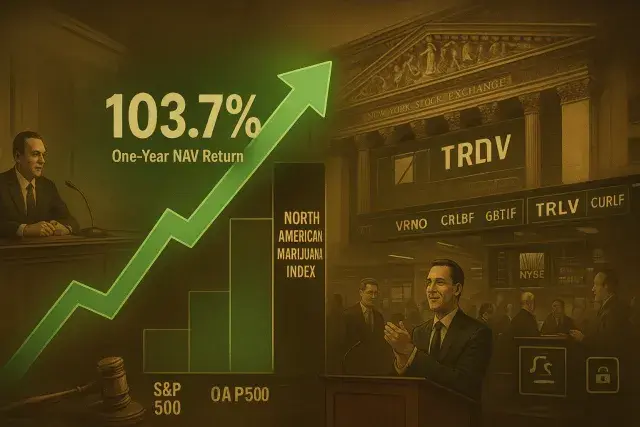
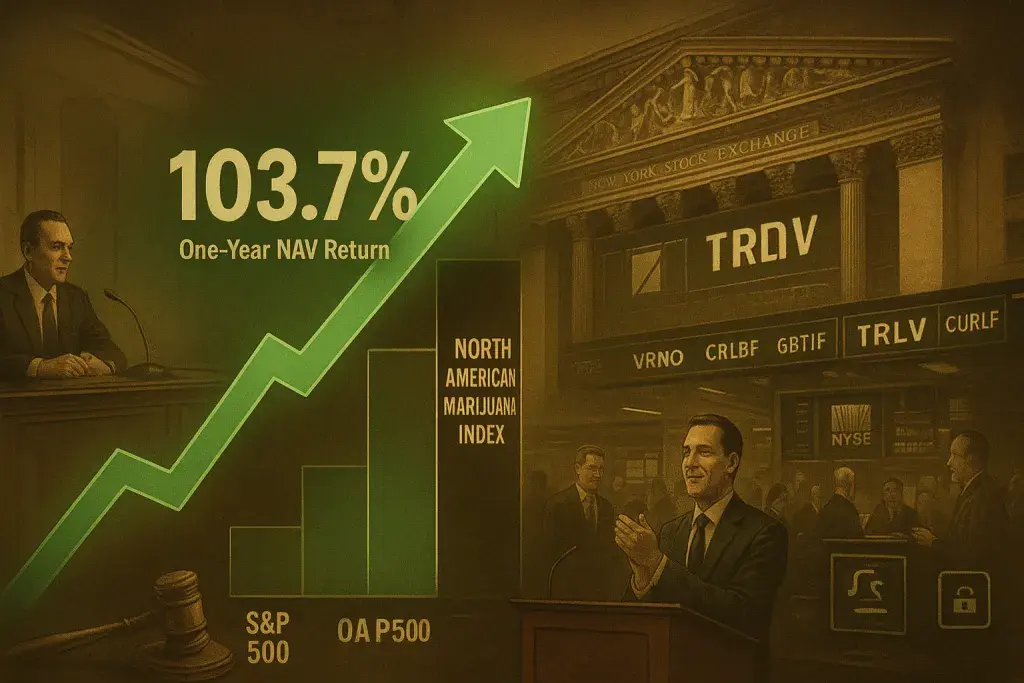
Money is flowing into cannabis equities at a pace the sector hasn't seen in years, and the trigger isn't a new product launch or a state legalization vote - it's a paperwork question in Washington. The AdvisorShares Pure US Cannabis ETF (MSOS) posted a 103.7% one-year NAV return as of May 31, more than doubling the North American Marijuana Index's 36.9% gain and dwarfing the S&P 500's 29.8% climb. With $1.13 billion in assets as of June 5, the fund has become the clearest proxy for how institutional money is pricing the odds of federal rescheduling.
Trulieve Cannabis, MSOS' largest position at roughly 30% of assets, began trading on the NYSE under TRLV this week, a move the company achieved by splitting its medical and adult-use operations into separate structures. That kind of corporate restructuring isn't cosmetic. It's the same operational discipline multi-state operators apply when they clean up SKU management or tighten seed-to-sale tracking ahead of an audit - the goal is to present a business that satisfies a senior exchange's governance standards, not just a growth story. For operators watching from the sidelines, the lesson is that uplisting requires the kind of back-office rigor - audited financials, segregated business lines, clean compliance logs - that many cannabis companies still haven't built out, in part because so much capital has gone toward dispensary buildouts, point-of-sale terminals, and a compliant pos system for dispensary operations rather than corporate infrastructure. pos system for dispensary
The DEA Hearing Behind the Rally
The real catalyst lands June 29, when a DEA administrative hearing opens to examine whether marijuana should move to Schedule III - not just for state-licensed medical products, which already got that treatment in April, but for the broader cannabis market including adult-use. The proceeding is expected to run through mid-July. That April move by Acting Attorney General Todd Blanche already eliminated a specific tax penalty for licensed medical operators: it let them start deducting ordinary business expenses like payroll, rent and interest, expenses that Section 280E of the federal tax code had long forced cannabis companies to treat as non-deductible because marijuana remains a Schedule I substance. Trump's decision to formally nominate Blanche as permanent attorney general has only reinforced investor confidence that the rescheduling track continues.
Here's the mechanism that matters for operators: 280E doesn't just squeeze margins, it distorts how MSOs structure everything from wholesale pricing to inventory shrinkage accounting, because so much hinges on what counts as cost of goods sold versus a non-deductible operating expense. Extending Schedule III treatment to adult-use products would be the difference between a plant-touching business filing taxes like a regulated retailer and filing like it's still running an illicit operation on paper.
Capital Access Starts Moving First
Rescheduling optimism is already showing up in financing activity. Cresco Labs secured a $50 million revolving credit facility from Needham Bank this week, which CEO Charlie Bachtell described as a non-dilutive tool for acquisitions and a step toward eventual uplisting. Roth Capital called the broader rescheduling order "extremely favorable," pointing to improved access to capital, banking services and institutional investors - three things cannabis operators have chronically lacked under federal prohibition, forcing many toward cash-heavy operations and limited banking relationships. Tilray Brands, not an MSOS holding but clearly reading the same signals, has floated using proceeds from a recent at-the-market offering to fund acquisitions.
Where the Upside Actually Sits
Trulieve may be the headline name, but it isn't where analysts see the biggest re-rating potential. According to Koyfin data cited by market watchers, Verano (VRNO) carries roughly 195% upside to its price target, followed by Jushi Holdings (JUSHF) at 183% and Cresco Labs (CRLBF) near 99%. Among the larger holdings, Green Thumb Industries (GTBIF) shows about 70% upside - well ahead of both Trulieve and Curaleaf (CURLF), the world's largest cannabis company by revenue. Retail sentiment on platforms like Stocktwits has run "extremely bullish" on MSOS, TCNNF and GTBIF, though enthusiasm on a message board isn't the same thing as regulatory certainty.
- Schedule III rescheduling would ease 280E tax burdens but doesn't equal federal legalization
- Uplisting to senior exchanges requires audited financials and structural separation of business lines
- Banking and institutional capital access remain constrained until federal law shifts further
- Price target upside varies sharply across MSOS holdings, with smaller names showing steeper projected gains
None of this changes the ground-level reality for dispensary operators: compliance obligations, lab testing requirements, age-verification rules and state-by-state packaging standards stay in place regardless of what happens in a DEA hearing room. Federal tax relief and exchange access matter enormously for balance sheets, but they don't substitute for the operational fundamentals - clean COAs, accurate delivery manifests, functioning compliance software - that keep a licensed retailer in good standing. The market may be pricing in a turning point. The stores still have to run like regulated businesses either way.