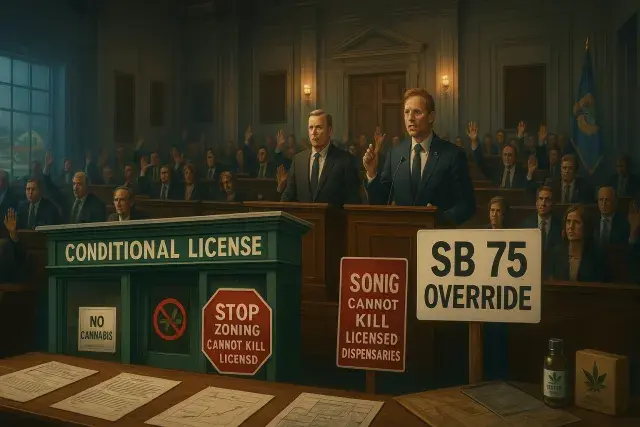
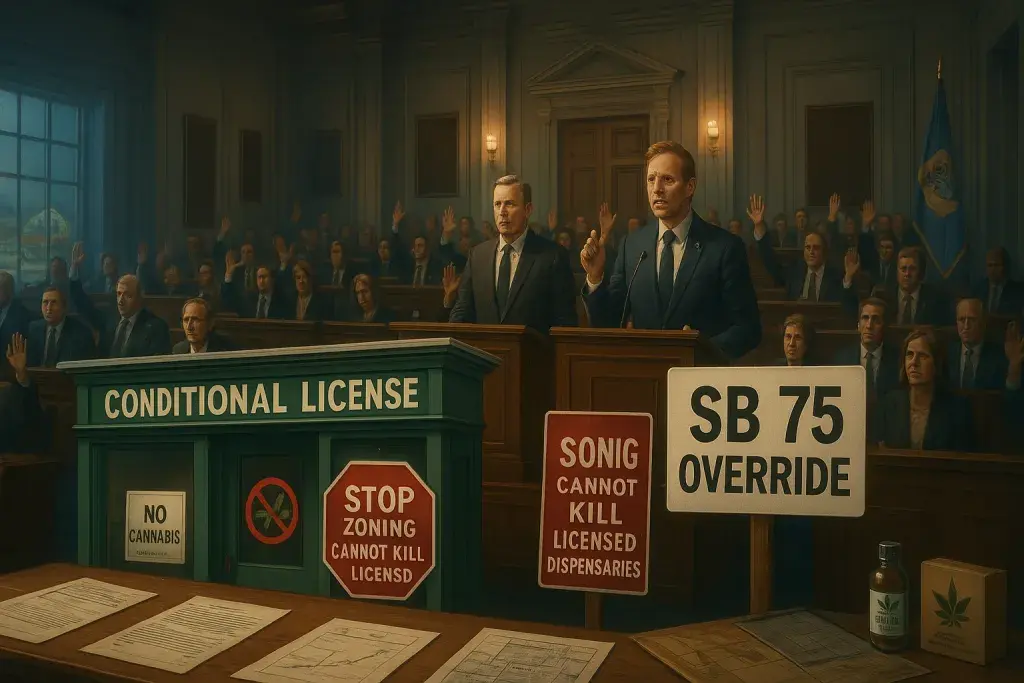
Delaware's General Assembly has voted to override Gov. Matt Meyer's veto of Senate Bill 75, a measure that bars local governments from using zoning rules to effectively prohibit state-licensed cannabis businesses from operating. The House voted 25-16 in the early hours of Wednesday morning, following a Senate override earlier this year. The decision resolves a months-long standoff that left conditional license holders in legal limbo-holding state-issued licenses with nowhere to open their doors.
For operators, investors, and anyone tracking the business mechanics of new adult-use markets, this is the kind of regulatory friction that doesn't make headlines until it's already cost someone a build-out budget. A state can legalize cannabis, stand up a licensing program, and still produce a market that barely functions-if local zoning authority is left unchecked. Delaware's situation is not unique; other states have wrestled with the gap between state-issued licenses and local land-use obstruction. Operators building compliance infrastructure or evaluating multi-market entry can read more about how adjacent regulated markets have handled similar structural pressures. The core problem in Delaware was straightforward: the state issued licenses but offered no statewide floor ensuring those licenses could actually be used. That is not a regulatory system. That is a waiting list with no destination.
Senate Bill 75 does not strip counties of land-use authority wholesale. Sponsor Sen. Trey Paradee (D) was precise about the scope: the legislation establishes a minimum statewide standard-a baseline-so that a state-issued license has a realistic path to a physical operating location. Reasonable setbacks and safety rules remain intact. What changes is the ability of local governments to impose zoning conditions so restrictive that they amount to a de facto ban on a legal, state-authorized industry. The distinction matters for operators writing lease agreements, negotiating with landlords, and modeling site-selection risk. Prior to SB 75's passage, a conditional license in Delaware offered no reliable assurance that a compliant retail location could actually be approved in any given jurisdiction.
When Licensing Systems Promise More Than They Can Deliver
Delaware's adult-use market launched last August. The governor noted that the first weekend of combined medical and adult-use sales approached $1 million-a number that drew favorable attention. Compliance checks showed the regulated market was operating within the law. On the surface, a functioning market. Here's the catch: the number of operating retail dispensaries has not meaningfully grown since legalization. Conditional license holders-many of them small operators and prospective social equity entrants who went through the application process in good faith-remain stuck.
This is a structural problem with real balance-sheet consequences. An operator holding a conditional license is carrying costs-legal fees, compliance preparation, real estate prospecting, consultant fees, POS system evaluation-without generating a dollar of revenue. Capital doesn't wait indefinitely. When local zoning functionally bars a licensed business from opening, the license itself becomes a liability rather than an asset. The concern Paradee raised in his floor remarks-that Delaware's word to investors and entrepreneurs is "conditional"-is not rhetorical. Site-selection risk compounds underwriting risk in early-stage cannabis retail. Landlords in restrictive jurisdictions have little incentive to sign cannabis tenants; lenders and investors read local-level obstruction as a signal that the market isn't actually open.
Meyer's position-that local governments, not the state, should decide where cannabis businesses operate-reflects a genuine tension in how legalization frameworks are built. His concern about proximity to schools is not novel; nearly every adult-use state enforces setback requirements from schools, playgrounds, and other sensitive-use sites. The question SB 75 actually addresses is different: not whether setbacks should exist, but whether local governments can stack restrictions on top of state law until no viable location remains. That is the difference between regulation and paralysis, to use Paradee's own framing-and it's a distinction that operators in any regulated retail category understand immediately.
The Illicit Market Argument Has an Operational Dimension
Paradee's warning about a weak legal market strengthening the illicit market is a familiar argument in cannabis policy circles-but it has a concrete operational dimension that often gets lost in the political framing. Illicit operators carry no licensing costs, no compliance overhead, no lab-testing requirements, no compliant packaging obligations, no excise tax liability, and no site-selection constraints. Every month a licensed dispensary cannot open is a month its unregulated competition operates without those burdens. The competitive asymmetry is not abstract.
A functional legal market requires accessible retail. That means licensed dispensaries in locations consumers can actually reach-not just in theory, but in practice, with real storefronts, compliant point-of-sale systems, age-verification protocols, seed-to-sale tracking, and the full compliance infrastructure that distinguishes a regulated operator from an illicit one. Delaware launched with medical operators getting first access to adult-use sales, which drew its own criticism from prospective retailers who felt the ramp was unfair. Add local zoning obstruction to that dynamic, and the pipeline of new retail entrants slows to a crawl. SB 75 is, at its core, an attempt to make the licensing infrastructure the state built in 2023 mean something in practice.
What Operators and Investors Should Watch Now
The override is a policy correction, not a market accelerant. Conditional license holders still face regulatory approvals before they can open. Delaware's Office of Cannabis Management has its own timeline and process, and the state's broader rollout has already encountered delays-a background check processing issue pushed the initial sales launch back from a projected start of last March to August. Clearing one obstacle does not clear all of them.
What changes is the legal environment for site selection. Operators can now pursue locations without local zoning being used as a quiet veto over state-issued licenses. Landlords, real estate brokers, and investors underwriting cannabis retail in Delaware have a clearer signal: a state license should now carry a more reliable path to a physical footprint. That is meaningful for deal structuring, lease negotiation, and capital deployment decisions. The broader lesson-one that plays out in market after market-is that legalization alone does not produce a functioning regulated industry. The infrastructure has to work end-to-end: licensing, compliance, retail access, and a local land-use environment that doesn't quietly nullify what the state has authorized. Delaware just closed one of those gaps. The others remain.