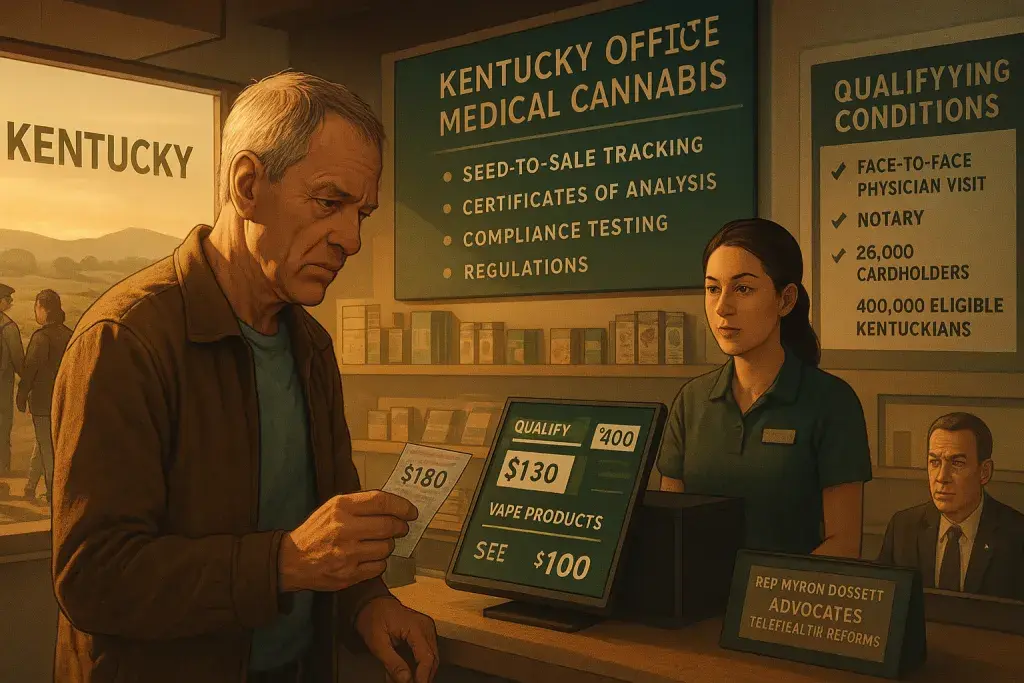
Kentucky's medical cannabis program is operational, but for thousands of patients living with chronic pain, legal access and affordable access are turning out to be two very different things. With a July 1 executive order expiration now forcing in-state purchases, patients who previously crossed state lines for lower-cost products are confronting retail prices that can run five times higher than what neighboring markets offer. The cost gap is real, it's documented in legislative testimony, and it's already pushing some patients toward illegal alternatives.
The Price Floor Problem: Why a New Market Costs More
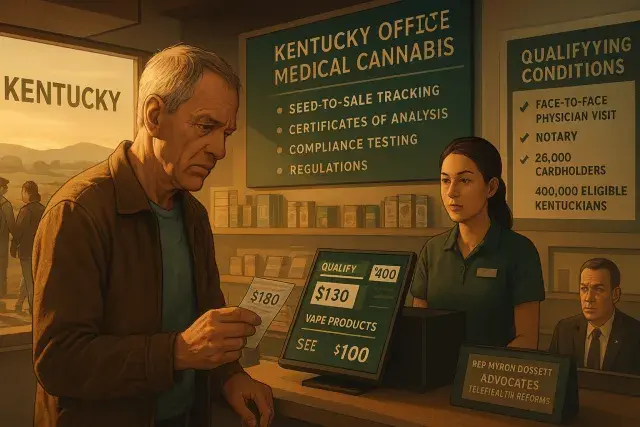
The arithmetic here is straightforward, even if the politics are not. Kentucky's five surrounding states that legalized medical cannabis before the Commonwealth did have had years to expand cultivation, add processing capacity, and drive wholesale prices down through volume. Kentucky's licensed producers are just getting operational. Fewer cultivating and processing facilities mean constrained supply; constrained supply means higher wholesale costs; higher wholesale costs translate directly into what patients see on the dispensary menu. The state's Office of Medical Cannabis has publicly acknowledged that the average retail cost of medical cannabis in Kentucky currently ranges from roughly $40 per unit for edibles to more than $100 for vape products - figures that Ricky Hunt, a 60-year-old Hopkinsville resident with a lifelong spinal cord condition, described in blunt terms before a state legislative committee. Hunt cited a specific price comparison: a one-gram vape cartridge available for $24 in Metropolis, Illinois, versus $130 at a Kentucky dispensary. That's not a marginal difference. That's a structural cost problem embedded in a program that hasn't yet had time to mature. Dispensary operators in other early-stage state markets have faced the same dynamic - for context, operators building out retail technology infrastructure in maturing markets, like those using a cannabis POS for Alaska dispensaries, know firsthand how supply constraints in a developing market can compress margins at every point in the chain, from cultivator to budroom counter.
A Thin Cardholder Base Compounds the Challenge
Kentucky had approximately 26,000 medical cannabis cardholders at the end of June. The state's Office of Medical Cannabis estimates that around 400,000 Kentuckians could qualify under existing conditions. That gap - between those eligible and those enrolled - matters enormously to dispensary economics. Retail cannabis operators depend on patient volume to spread fixed compliance costs across enough transactions to remain viable. When cardholder enrollment is low, per-unit overhead stays high, and dispensaries have less pricing flexibility. The Kentucky Cannabis Industry Alliance has pointed directly at structural barriers keeping that enrollment number down: a face-to-face physician requirement for card approval, a notary requirement, advertising restrictions, and a rigid list of qualifying conditions rather than physician discretion. Each of these adds friction to the patient enrollment process. Less enrollment means thinner wholesale demand from dispensaries, which in turn gives cultivators and processors less incentive to scale quickly. It's a slow feedback loop - and patients who can't afford current prices are the ones absorbing the cost of waiting for it to resolve.
The Compliance and Safety Argument for Keeping Patients In-State
There's a legitimate regulatory rationale behind encouraging patients to purchase from licensed Kentucky dispensaries rather than traveling to Michigan or Illinois. Products sold through Kentucky's licensed retail channel meet state-mandated testing standards, carry Certificates of Analysis tied to specific batches, and are tracked through seed-to-sale systems that regulators can audit. Rachel Roberts of the Kentucky Cannabis Industry Alliance made that point explicitly before the legislative committee - high-volume markets don't always guarantee equivalent testing rigor, and patients who self-source from out-of-state programs, particularly informal ones, are effectively stepping outside the consumer protections Kentucky's licensed supply chain was built to provide. The compliance argument is sound. The problem is that it only holds if patients can actually afford the compliant option. Committee Co-Chair Rep. Myron Dossett, a Republican from Pembroke, articulated the risk plainly: price-driven patients don't disappear from the market, they move to unlicensed sources. That's bad for patient safety, bad for licensed operators competing against zero-cost underground supply, and bad for a regulatory framework that depends on market participation to function.
What Legislative and Regulatory Reform Could Change
The Kentucky Cannabis Industry Alliance is pressing for a specific set of reforms, each of which has a direct connection to either expanding the patient base or reducing compliance friction for operators. Telehealth approval for medical cards would lower the access barrier for rural patients - a significant consideration in a state with substantial agricultural and underserved communities. Physician discretion over qualifying conditions could broaden the eligible patient pool beyond what current statute specifies. Eliminating the notary requirement removes a procedural step that adds time and cost without a clear safety benefit. Easing advertising restrictions would give licensed dispensaries tools to reach potential patients who don't yet know they qualify. None of these changes require the state to subsidize cannabis purchases. They're structural adjustments that, if enacted, would expand the cardholder base, increase dispensary transaction volume, and create the market conditions under which wholesale prices begin to compress naturally. State regulators have indicated that more cultivation and processing licenses are on the way, which will help on the supply side. But supply expansion alone won't close a fivefold price gap quickly. The policy levers on the demand side matter just as much - and right now, they're largely untouched.