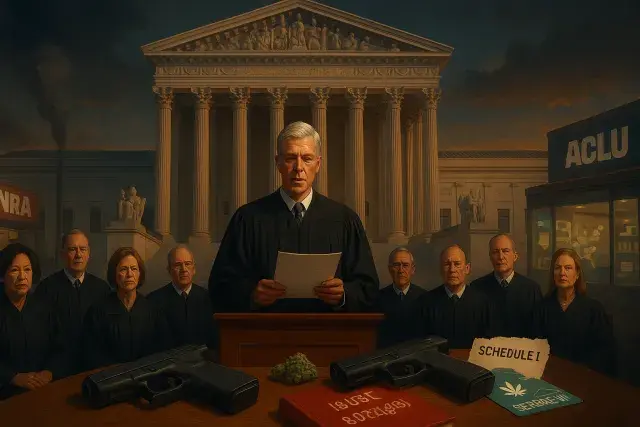
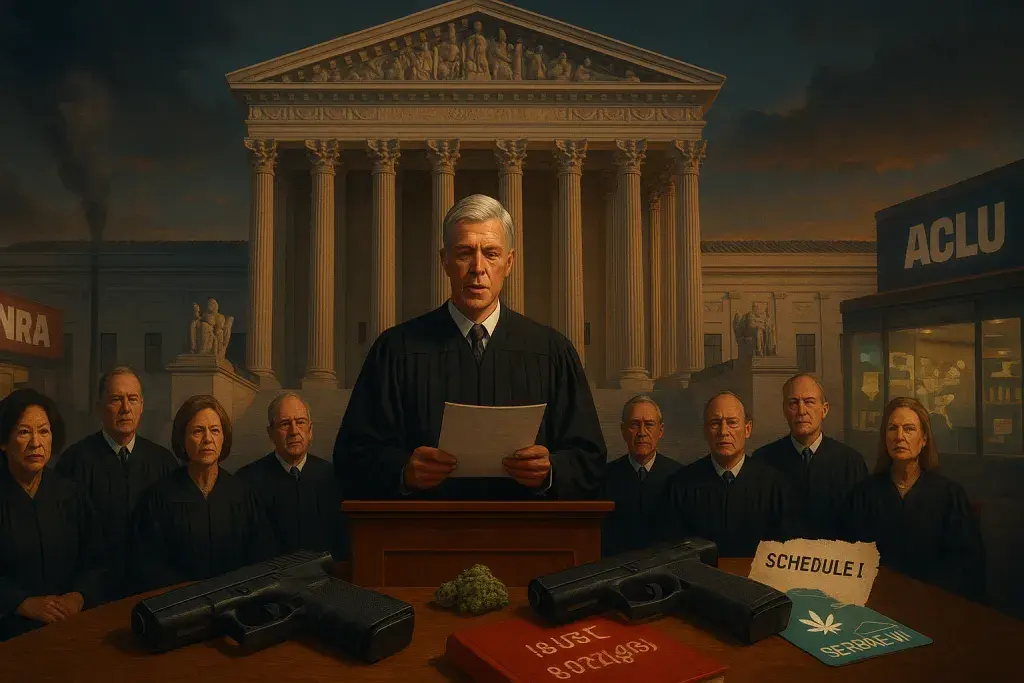
The Supreme Court handed down a unanimous 9-0 ruling on June 18 that federal prosecutors cannot strip a person's firearm rights solely on the basis of cannabis use, with no additional evidence of danger or violence. The decision in U.S. v. Hemani invalidates the government's bluntest enforcement theory under 18 U.S.C. § 922(g)(3) - the statute that bars "unlawful" drug users from owning firearms - while leaving the law itself intact for narrower applications. For the licensed cannabis industry, the ruling arrives at a moment when every branch of the federal apparatus is sending contradictory signals about how seriously it treats cannabis prohibition.
The case came out of Texas, where agents found a Glock 9mm and roughly 60 grams of cannabis in Ali Danial Hemani's home in 2022. He had told agents he smoked about every other day. No violence, no intoxication charge, no other crime - just the combination of a gun and a stash. The government argued that pattern alone placed him in a categorically dangerous class of people who could be stripped of Second Amendment rights and exposed to up to 15 years in federal prison. Nine justices disagreed. Writing for the court, Justice Neil Gorsuch rejected the government's position that "anyone who regularly uses marijuana is categorically violent and dangerous without any further showing." What makes Gorsuch's opinion particularly pointed is the mechanism he used to reach that conclusion: the government's own regulatory retreat on cannabis. Operators already tracking state compliance requirements - from seed-to-sale software in New Mexico to cannabis point of sale maine platforms that sync with METRC - know better than anyone that the regulated industry has been built on a foundation of ongoing federal contradiction. Gorsuch named it directly from the bench.
The specific contradiction Gorsuch flagged is the rescheduling. Earlier this year, an April order from Acting Attorney General Todd Blanche moved state-licensed and FDA-approved medical marijuana to Schedule III under the Controlled Substances Act. Gorsuch wrote that Washington "has not just tolerated" the expansion of state-legal cannabis markets, "it helped fuel" it. Then the same federal government walked into court arguing that people who use that increasingly normalized substance are too dangerous to touch a firearm. The court described the government as "awkwardly positioned." That is a restrained way of saying the argument was internally incoherent.
What the Ruling Does - and Doesn't - Change
§ 922(g)(3) still exists. The ruling did not strike down the statute. What it dismantled was the government's broadest enforcement posture: the theory that any regular cannabis user is automatically disqualified, full stop, without individualized proof of danger. Gorsuch was deliberate about what the court left open. Prosecutions grounded in evidence of addiction can proceed. So can cases where a person was actually intoxicated while handling a firearm, or where specific facts establish that an individual's drug use creates genuine risk. The shortcut - point at the weed, call it done - is gone.
The legal standard underneath this is the Bruen framework, established in the court's 2022 Second Amendment decision, which requires that any gun restriction map to the historical tradition of firearm regulation in America. The government's strongest historical analogy was old laws targeting "habitual drunkards." Gorsuch found that analogy weak. Those laws, he wrote, were designed to protect drunks and their families from financial harm - not to brand them violent threats. Justice Samuel Alito, joined by Justice Elena Kagan in a concurrence, pushed the same point: the government never established that Hemani's every-other-day use rendered him as impaired or as dangerous as the historical archetype. Potency, frequency, impairment, judgment - none of it was shown. The government just knew he used.
The court also noted the obvious about scale. Roughly 40 states have legalized cannabis in some form. Federal surveys count regular users in the tens of millions. The opinion drew the comparison plainly: "marijuana use today is like alcohol use at the founding" - ubiquitous, socially normalized, and largely waved through by law enforcement. That framing matters because it shapes how future prosecutions under § 922(g)(3) will be scrutinized.
Compliance and Regulatory Pressure Don't Disappear
For dispensary operators and multi-state operators, this ruling is not a sales event. It does not change state licensing requirements, product testing mandates, compliant packaging rules, or the daily operational weight of running a regulated cannabis retail business. What it does is reinforce something the industry has argued for years: federal cannabis policy is a patchwork of contradictions, and the courts - not just legislators - are starting to say so out loud.
The Bureau of Alcohol, Tobacco, Firearms and Explosives already updated Form 4473, the federal form required to purchase a firearm from a licensed dealer, to account for medical cannabis's new Schedule III status. ATF also moved this year to revise its definition of who counts as an "unlawful user" under the same statute, with a public comment period open through June 30. A broader DEA hearing on rescheduling is scheduled for later this month. None of that constitutes federal legalization. Rescheduling to Schedule III does not remove cannabis from the Controlled Substances Act, does not resolve 280E tax treatment for plant-touching businesses, and does not unlock traditional banking access for operators who still rely on cash-heavy workflows or alternative payment processors. Those compliance pressures remain fully intact.
The political coalition this case assembled is worth a moment's attention. The American Civil Liberties Union served as co-counsel for Hemani. The National Rifle Association backed him. NORML filed in support. Lined up on the other side - defending the Trump administration's position - were 19 state attorneys general, the anti-legalization group Smart Approaches to Marijuana, and the gun control organization Everytown for Gun Safety. That alignment reflects how thoroughly cannabis policy now scrambles conventional political categories. The industry should not read unusual coalitions as durable political cover, but the breadth of support for the Hemani position says something about where public consensus has moved.
The Federal Government Now Needs to Pick a Position
The ruling puts pressure on Congress and the executive branch that no administrative memo can fully absorb. Gorsuch's majority opinion handed the government its own rescheduling decision as evidence against its courtroom argument. That is not a subtle message. The federal posture on cannabis - simultaneously loosening Schedule I restrictions while maintaining criminal exposure for users in other contexts - cannot hold indefinitely without generating more cases that look exactly like this one.
Smart Approaches to Marijuana's response signals what comes next on the legislative side. CEO Kevin Sabet said after the ruling that the organization is "working now with our allies in Congress to strengthen protections against more marijuana-induced violence, consistent with today's narrow ruling." That is a direct statement of intent to use the statute's surviving applications as the basis for new legislative action. Operators, industry associations, and compliance professionals should track those efforts carefully - because the next version of this fight may arrive through Congress rather than the courts, and a narrower statutory fix could impose new documentation or proof requirements that affect how retailers advise staff or structure their hiring and HR policies.
For now, the practical takeaway is precise: the government cannot use cannabis use as a standalone disqualifier for firearm ownership without individualized evidence of danger. The broader statutory and regulatory apparatus stays in place. The industry's compliance obligations do not change. But the federal government's credibility as a consistent arbiter of cannabis-related risk just took a direct hit from its own Supreme Court - and the opinion was signed by all nine justices.