Vietnam's tourism sector is no longer measuring success in arrival numbers alone. As the country recorded 8.8 million international visitors in the first four months of 2026 - a reported record for that period - official policy is steering the sector toward a fundamentally different kind of expansion: one tied to plastic reduction, cleaner destination management, lower environmental impact, and a longer-term view of what keeps a travel economy competitive.
A Growth Record That Creates Its Own Pressure
Strong visitor numbers are genuinely good news for Vietnam's hospitality operators, tour businesses, and local communities. The 8.8 million arrivals in January through April represent 35 percent of the country's 2026 target of 25 million international visitors. Source markets span China, South Korea, Russia, Taiwan, Cambodia, the United States, India, Japan, Australia, and the Philippines - a broad mix that signals both recovery depth and growing demand diversity.
Here's the catch, though. Higher arrivals at this pace put direct pressure on coastal zones, heritage towns, national parks, waste systems, and water infrastructure. Vietnam's most visited destinations were already showing strain before the 2026 recovery took hold. More visitors bring more revenue, but they also bring more plastic waste, more foot traffic on fragile sites, and more demand on services that were not built for mass volumes. The policy response recognizes this tension directly.
What the National Plan Actually Requires
Vietnam's master plan for tourism development, covering 2021 through 2030 with a vision extending to 2050, ties visitor growth targets to green growth obligations. By 2030, the country aims to welcome 35 million international arrivals and 160 million domestic tourists, with tourism contributing 13 to 14 percent of national GDP. Those are large numbers - and the plan is explicit that reaching them sustainably requires structural changes, not just volume scaling.
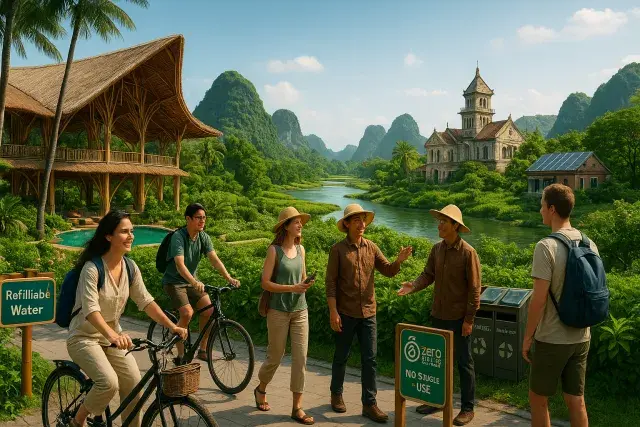
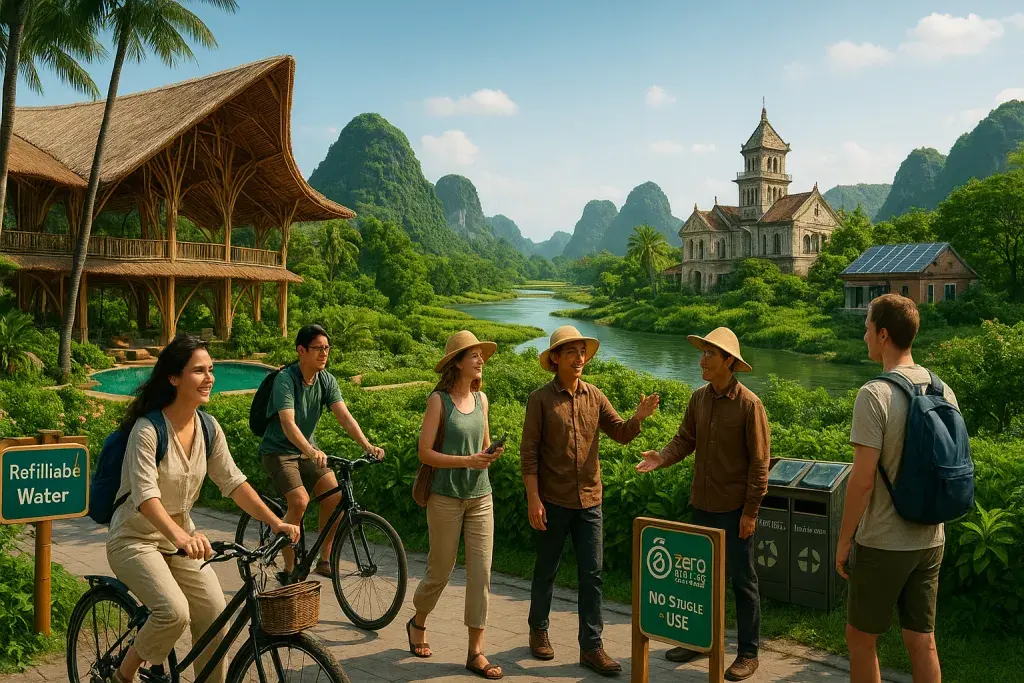
The most operationally specific green target is the 2030 deadline for eliminating single-use plastics. Under the plan, all tourist areas, accommodation establishments, and coastal service businesses are expected to stop using single-use plastic products and non-biodegradable plastic bags by that year. For hotels, beach resorts, island operators, and tour companies, this is not a soft aspiration. It points toward refillable water systems, reusable packaging, waste sorting infrastructure, and procurement changes that affect supplier relationships and operating costs. What's striking here is that this target reaches across the entire hospitality supply chain - from the five-star resort to the coastal food stall.
Vietnam's National Green Growth Strategy, running parallel to the tourism plan, adds further context. Targets include reducing greenhouse gas emissions per GDP by at least 15 percent by 2030, pushing renewable energy toward 15 to 20 percent of primary energy supply, and ensuring that at least 95 percent of urban solid waste is collected and properly treated. None of these are tourism-specific mandates, but they shape the operating environment for any hotel, resort, or tourism business that depends on energy, water, and waste services in urban or coastal locations.
Where the Real Implementation Challenge Sits
Policy frameworks and destination-level execution are two different things - and Vietnam knows it. The country's green tourism direction covers a wide range of sectors: energy, waste, transport, construction, hospitality operations, visitor management, and community economics. Coordinating those moving parts across regional governments, private operators, and international tourism channels is genuinely complicated.
In practice, the most visible gaps tend to appear at the destination level. A national plastic-free target means little if provincial authorities lack waste collection capacity or if small accommodation providers have no affordable sourcing alternatives for packaging. Heritage town crowd management only works if local operators are equipped with booking systems and visitor flow tools. Nature-based tourism stays low-impact only if national park management has the staffing and infrastructure to enforce it.
Vietnam's official planning identifies Hanoi as a northern tourism hub, with Ho Chi Minh City and Da Nang recognized as key regional growth poles. These gateways matter for green tourism because they determine how visitor flows distribute across the country. If gateway cities can efficiently direct travelers toward lesser-known destinations - mountain communities, river delta areas, craft villages, rural landscapes - the pressure on the most overburdened sites eases. That kind of geographic balance is a legitimate sustainability tool, not just a marketing angle.
What the Shift Means for Tourism Businesses
For hospitality operators, the direction is clear enough: investment in waste reduction, plastic-free operations, energy efficiency, water conservation, and local sourcing is moving from voluntary to expected. Eco-certified properties already have a commercial edge with environmentally aware travelers from markets like Australia, the United States, and parts of Europe. As Vietnam's green standards formalize, certification may shift from differentiator to baseline requirement.
For tour operators, the space for low-impact itineraries - cycling routes, walking tours, community-based rural experiences, responsible wildlife programs - is expanding as traveler preferences shift toward meaningful, culturally grounded trips. The volume-driven tour model that stacks arrivals onto a short list of famous sites is, to put it plainly, not where the policy or the market is heading.
Vietnam's green tourism transition is arriving at a moment when the country has real momentum. The arrival numbers support investment confidence. The policy framework gives operators a direction to plan against. The gap - and it is a real one - is between the national targets and the ground-level capacity to meet them within the next several years. Closing that gap is the operational challenge Vietnam's tourism sector now has to work through.