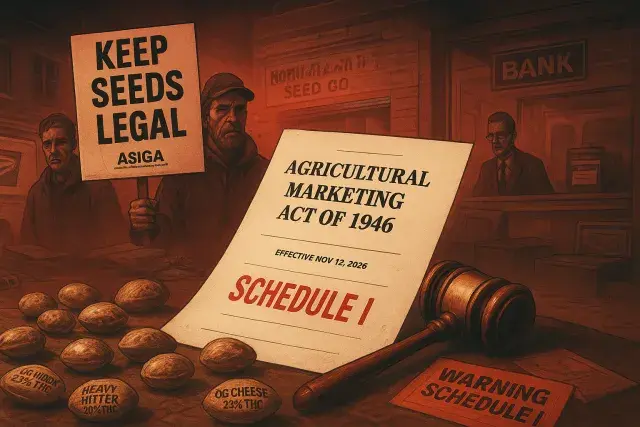
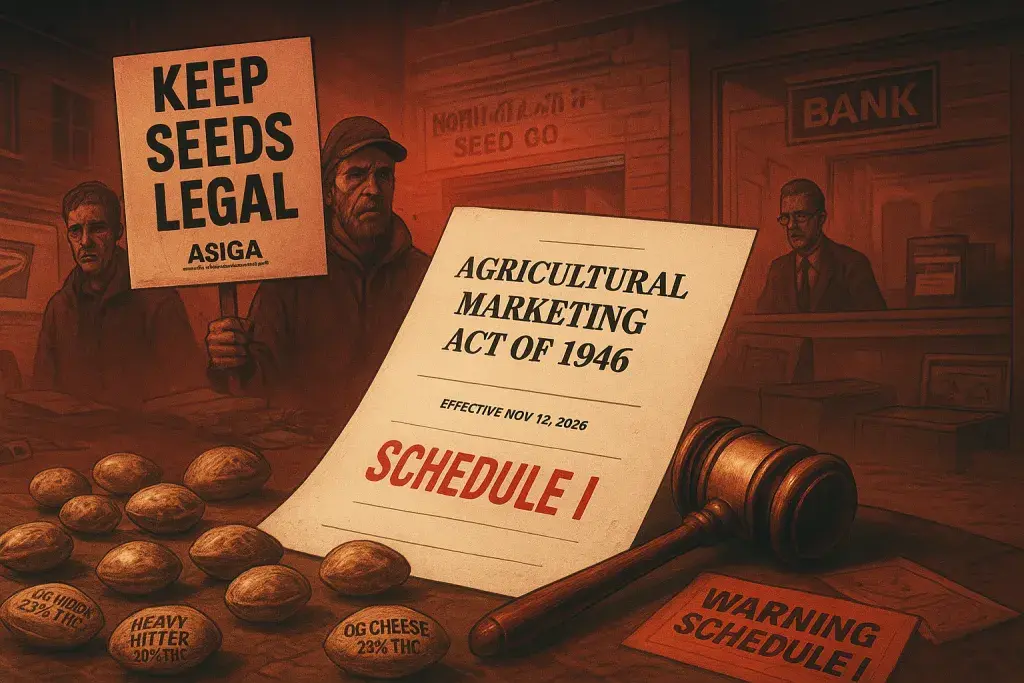
A single section buried inside the FY2026 Agriculture Appropriations Act is set to upend the American cannabis seed trade. Signed into law in November 2025, the bill redefines hemp under the Agricultural Marketing Act of 1946, and in doing so, strips legal protection from viable cannabis seeds derived from plants that test above 0.3% total THC. The provision, Section 781, takes effect November 12, 2026 - and unless it is amended or repealed before then, it will reclassify most cannabis seeds sold in the U.S. as Schedule I material, regardless of the fact that seeds themselves carry no measurable THC.
The mechanics here matter for anyone touching the cannabis supply chain, not just breeders. The 2018 Farm Bill's original hemp definition covered "the plant Cannabis sativa L. and any part of that plant, including the seeds thereof," with the 0.3% THC threshold applied to the plant, not the seed. That ambiguity let seed and genetics companies operate across state lines under a reasonably solid legal theory. Section 781 closes that loophole by excluding seeds traced to any parent plant exceeding 0.3% THC - which describes nearly every cultivar grown for adult-use or medical markets today. Operators already juggling 280E tax exposure, METRC reporting, and volatile wholesale pricing now have to think about whether their genetics supply chain survives the next twelve months. Retail-side technology providers aren't immune either; a dispensary running cannabis pos systems south dakota style - tracking seed-to-sale data, batch lineage, and COA records - will need that infrastructure to prove compliance if seed sourcing becomes a federal enforcement flashpoint. cannabis pos systems south dakota
The practical fallout is not abstract. Once seeds fall outside the legal definition of hemp, banking access disappears for breeders and seed companies almost overnight - payment processors and depository institutions won't touch Schedule I inventory, full stop. Shipping carriers such as USPS would be barred from transporting seeds tied to high-THC genetics. Interstate commerce in plant genetics, the backbone of breeding programs and biodiversity preservation, effectively halts. That's not a compliance inconvenience; it's an extinction event for rare landrace strains and specialized cultivars that took decades to stabilize.
Why the Industry Went Quiet
Here's the catch that should worry operators more than the statute itself: the loudest advocacy against Section 781 isn't coming from cannabis multistate operators. Alcohol beverage trade groups pushed hard for the hemp redefinition, framing intoxicating hemp-derived products as unregulated competition undercutting regulated alcohol sales. Meanwhile, companies that have poured resources into federal rescheduling lobbying have stayed largely silent on seed criminalization. That silence is notable. Seeds are upstream of every dispensary shelf, every wholesale menu, every product batch that eventually clears lab testing and lands in compliant packaging. If genetics access narrows to a handful of patent holders, the downstream effects - wholesale pricing, SKU diversity, cultivar availability - ripple through every licensed operator's budroom inventory.
Consolidation Risk Behind the Regulatory Language
Put plainly: control the seeds, and you control production. If Section 781 stands unmodified, plausible follow-on scenarios include licensed cultivation restricted to patented genetics held by well-capitalized firms, THC caps applied at the genetic level, or the elimination of home cultivation exemptions in states that currently allow them. Any of those outcomes pushes more consumer demand toward licensed dispensaries and taxable retail transactions - which may explain the muted resistance from parts of the industry already positioned to benefit. For smaller breeders, seed banks, and craft cultivators, though, the math is brutal: no banking, no shipping, no interstate sales, no legal defense.
What Pushback Looks Like So Far
The American Seed Innovation and Growth Alliance (ASIGA) has emerged as the primary organized response, working alongside the North Atlantic Seed Co. on a "Keep Seeds Legal" campaign that has raised modest funds through crowdfunding and sponsored product sales. A public petition has gathered thousands of signatures calling for seeds to be removed from the bill's scope. Whether that pressure translates into a legislative fix before November 2026 remains genuinely uncertain. In the meantime, operators, wholesalers, and genetics companies would do well to treat this as a live compliance risk rather than a distant policy footnote - because the clock on Section 781 is already running.