Mendocino County, California, didn't just produce cannabis - it produced the political, economic, and cultural arguments that shaped how every regulated state eventually wrote its cannabis laws. Charlie Harris's new book, Mendo, documents that arc with the rigor of an economic historian and the instincts of a beat reporter. What emerges is less a nostalgic portrait of hippie growers and more a cautionary ledger: legalization, compliance costs, and oversupply didn't liberate Mendocino's cannabis economy. They gutted it.
That outcome - legal market structures crushing the very operators who built the industry - isn't unique to Northern California. Operators building out a cannabis retail platform for New York face structurally similar pressures: high licensing fees, excise tax burdens, compliance overhead, and wholesale pricing that can't compete with illicit supply. Harris's granular account of Mendo's trajectory reads, for anyone in the licensed cannabis trade, less like history and more like a preview.
How Compliance Costs Pushed Legal Growers Back Toward the Black Market
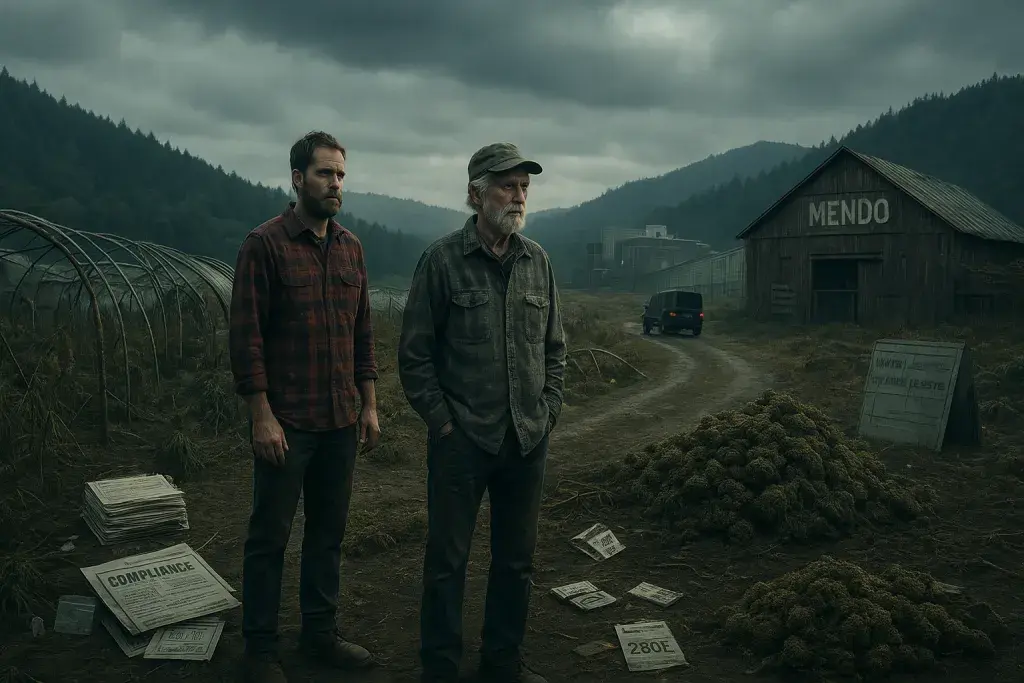
Harris profiles a third-generation Mendocino grower named Shaun, whose story captures the core economic trap of post-legalization cannabis. His father, Rocket, brought him into the business - but by the time California's adult-use framework went fully operational, complying with state licensing requirements cost more than the regulated market could return. The only profitable path, paradoxically, was to serve the unlicensed market.
That dynamic is well understood by dispensary operators and wholesalers across every mature cannabis state. Seed-to-sale tracking, mandatory lab testing, compliant packaging, excise tax, local taxes layered on top of state taxes, and METRC reporting don't come free. For small growers or boutique brands, the compliance stack can easily represent a cost structure that licensed wholesale pricing simply won't support. The result: licensed operators compete against untaxed, untracked product priced at margins they can't match. It's not a loophole problem. It's a structural one baked into how most states designed their tax and licensing frameworks.
Harris notes that by 2016, California was growing roughly five times more cannabis than its residents consumed. That oversupply collapse drove wholesale prices down sharply. For dispensary buyers, that sounds like good news - lower input costs, stronger margins. In practice, though, it meant the regulated supply chain was under pressure at every node, and the compliance infrastructure that legalization required was eating whatever margin remained.
The Tax Revenue Promise vs. the Operational Reality
One of Harris's sharpest contributions is his attention to the actual dollar figures cannabis taxation produced for Mendocino County's public coffers - right down to the last dollar in a given year. It's the kind of fiscal specificity that gets glossed over in policy debates. Cannabis taxation was sold to counties and states as a fiscal windfall. What it actually produced was more complicated: meaningful revenue, yes, but also a compliance regime that functioned as an entry barrier for the small operators who had built the industry, and an exit ramp toward the illicit market for growers who couldn't absorb the costs.
For licensed dispensaries, the parallel is 280E - the federal tax provision that, until rescheduling changes the calculus, prevents cannabis businesses from deducting ordinary business expenses because cannabis remains a Schedule I controlled substance under federal law. A dispensary running tight margins on a high-volume POS system, paying excise tax at the register and income tax at year-end without standard deductions, is in a structurally different position than any other retailer. The numbers Harris cites for Mendocino's weed-tax schemes reflect a similar tension: the public sector captured revenue while the operators generating it faced cost structures that made legal participation increasingly untenable.
What Mendo's Arc Tells the Licensed Cannabis Industry
Harris frames Mendocino County as a place that is "now most valuable as a simulacrum of itself" - a tourist draw for the culture it once embodied, while the economic engine behind that culture has largely collapsed. That's a pointed observation. And it raises a genuine question for the licensed cannabis trade: what does a regulated market look like when the small operators who gave it cultural and political legitimacy can no longer afford to participate in it?
The answer, playing out in California and increasingly in other mature markets, is consolidation. Multi-state operators with capital to absorb compliance costs, sophisticated inventory management systems, and wholesale relationships at scale are better positioned to survive compressed margins than the independent cultivator or single-location dispensary. That's not inherently wrong. But it is worth understanding clearly - especially for operators making licensing, real estate, and technology infrastructure decisions in newer regulated markets.
Mendo isn't a cannabis industry book per se. But it's one of the more instructive accounts available of what happens when a thriving informal economy gets formalized, taxed, and regulated - and what gets lost in the transaction. Harris is asking the same questions the cannabis trade is still working through: who benefits from legalization, who gets priced out, and whether the compliance architecture designed to replace the illicit market actually does that, or just reassigns which operators supply it.