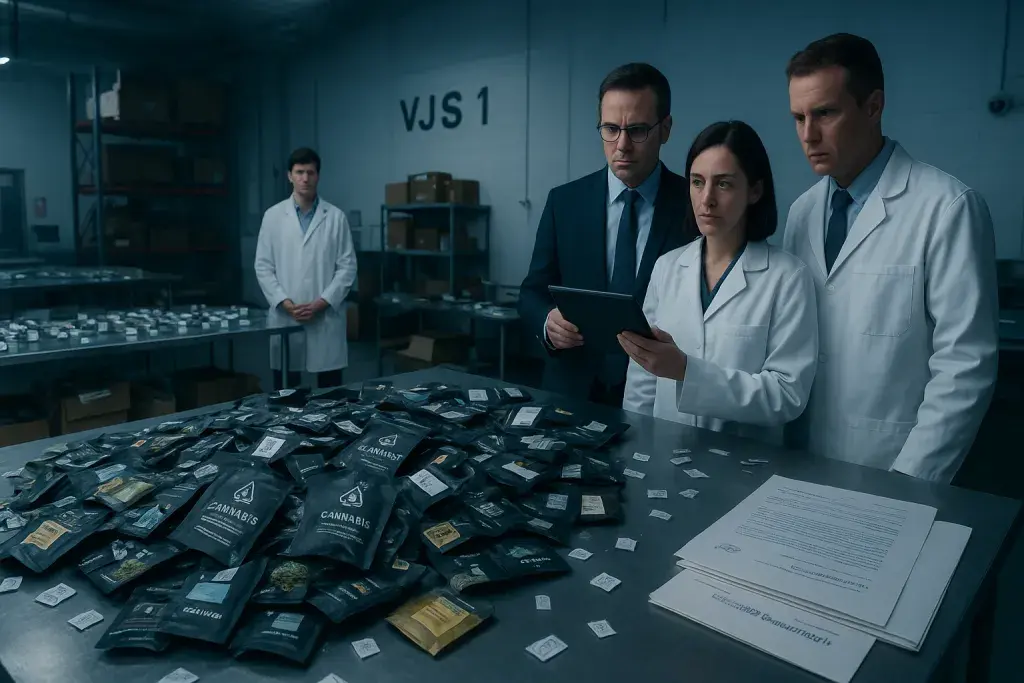
A Michigan cannabis processor is facing potential license suspension after state inspectors found more than 12,000 individual cannabis products without Metrc tags or any other identifying information at its Harrison Township facility. The Michigan Cannabis Regulatory Agency filed a formal complaint against VJAS 1, citing products in California-specific packaging - bearing "CA" designations and California consumer warning language - as evidence that the inventory may have been sourced from outside the state. For a licensed cannabis operation, that is about as serious as it gets.
Seed-to-sale tracking systems like Metrc exist precisely to prevent this kind of scenario. Every compliant cannabis product in Michigan's regulated market is supposed to carry a Metrc tag that ties it to a licensed origination point, a tested batch, and a chain of custody. The moment a product enters a facility without that tag, it falls outside the regulatory framework entirely - no verifiable lab result, no traceable origin, no compliant transfer record. Operators in other markets have learned this the hard way; even among those investing in robust dispensary point of sale new york infrastructure, back-end inventory integrity only holds if every product entering the system is properly tagged and accounted for before it ever touches a POS terminal or a wholesale menu. Untagged SKUs don't just create a compliance gap - they make accurate inventory reconciliation impossible.
What compounds the problem here is what inspectors found when they checked the products that did carry Metrc tags. Cross-referencing those tags against the state's system revealed that those items were supposed to be physically located at other licensed cannabis businesses. That detail matters enormously. It suggests the tagged inventory wasn't legitimately acquired by VJAS 1 through a proper wholesale transfer - it may have been removed from another licensee's tracked chain of custody entirely. In a tightly regulated market, Metrc tags aren't just labels; they're the operational proof that a transfer happened legally, that a product was tested, and that excise obligations were properly recorded along the way.
What the California Packaging Detail Actually Signals
Finding products in California-specific packaging inside a Michigan processor's facility is not a minor paperwork discrepancy. California mandates its own distinct compliant packaging format - specific warning language, symbols, and formatting that differ from Michigan's requirements. Products carrying that packaging were either manufactured for the California market or designed to mimic that market's labeling standards. Either way, they have no legitimate place in a Michigan licensed facility's inventory.
The presence of California-packaged products points toward a broader problem the regulated cannabis industry has struggled with since legalization spread state by state: the temptation to move product across state lines, where price differentials, supply imbalances, or demand gaps make it economically attractive. Cannabis remains a Schedule I controlled substance under federal law, which means interstate commerce - even between two legal states - is flatly prohibited. A processor caught with out-of-state product isn't just facing a licensing violation; it's sitting at the intersection of state regulatory action and potential federal exposure.
Employees Couldn't Explain It. That's Its Own Problem.
The CRA noted that employees at the facility were unable to explain why or how more than 12,000 untagged products were present. That operational detail is worth sitting with for a moment. In a compliant cannabis operation, every product on the floor should be accounted for - batch records, transfer manifests, inventory logs. Staff should be able to walk an inspector through the paper trail. When front-line employees can't explain a facility's own inventory, it points to either a failure of internal compliance training, a deliberate compartmentalization of information, or both.
For operators across Michigan and other regulated markets, this case reinforces why internal audit processes matter as much as the external compliance frameworks regulators impose. Regular physical inventory reconciliation against Metrc records, clear documentation protocols for every product receipt, and staff training on chain-of-custody requirements aren't optional enhancements - they're the baseline protection against exactly this kind of enforcement action.
The Regulatory and Business Stakes
VJAS 1 now faces fines along with the potential suspension, revocation, restriction, or non-renewal of its license. In practical terms, a license revocation doesn't just end one business - it wipes out the capital investment, the facility buildout, the regulatory fees, and whatever wholesale relationships the operator had established. For any investor-backed cannabis operation, that's a total loss scenario.
Michigan's CRA has demonstrated a consistent willingness to pursue formal enforcement against operators who fall outside compliance boundaries. The agency's complaint process is structured to apply graduated pressure - fines and restrictions first, revocation as an escalating option - but the threshold for serious action is clearly not high when inspectors turn up thousands of untagged products and evidence of out-of-state sourcing in the same visit. The message to the broader operator community is straightforward: Metrc compliance and clean inventory records are not administrative formalities. They are the operational foundation on which a license depends.