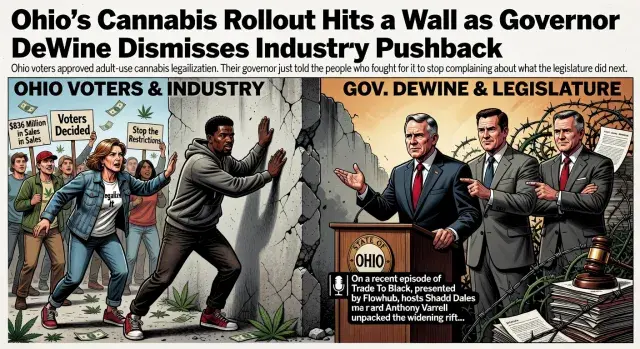
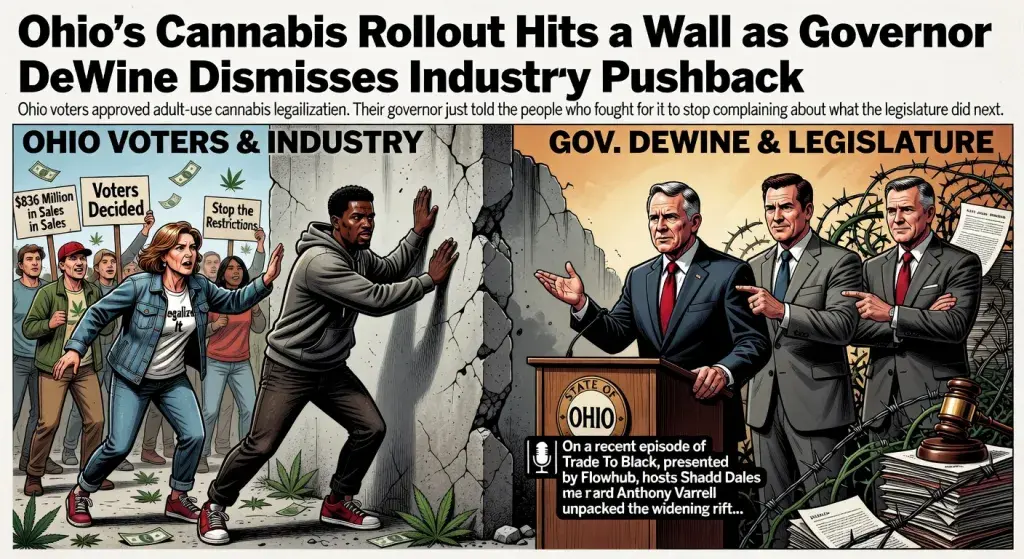
Ohio voters approved adult-use cannabis legalization. Their governor just told the people who fought for it to stop complaining about what the legislature did next. On a recent episode of Trade To Black, presented by Flowhub, hosts Shadd Dales and Anthony Varrell unpacked the widening rift between Ohio's voter-approved legalization framework and the GOP-backed restrictions now reshaping it - alongside a new retail partnership aiming to keep independent dispensaries from getting swallowed whole.
The Ohio Problem: $836 Million in Sales, a Thicket of New Restrictions
The numbers are hard to argue with. Ohio's recreational cannabis market generated $836 million in sales last year. And yet the regulatory environment operators face feels designed to suffocate momentum rather than channel it. SB56, which took effect on March 20th, introduced a battery of constraints that have drawn fierce criticism from the industry: a THC potency cap lowered to 35%, a prohibition on selling eighths - a standard consumer unit in virtually every other legal state - restrictions on out-of-home marketing and signage, and a web of pending lawsuits tangling up the broader rollout.
Governor Mike DeWine's response? He told advocates to "stop whining."
Both Dales and Varrell acknowledged one bright spot within SB56: the ban on intoxicating hemp products, which have long operated in a regulatory gray zone and undercut licensed operators. That provision, in principle, should benefit the legal market. But the concession feels marginal against the weight of everything else. A 35% THC cap, for instance, doesn't just limit product variety - it reshapes the competitive dynamics of the market by removing concentrates and high-potency flower that consumers in states like Colorado and Michigan take for granted. Operators are left selling a constrained product line while shouldering the full cost of compliance.
The broader pattern here isn't unique to Ohio, though the bluntness of DeWine's rhetoric is. Across the country, voter-approved legalization measures have repeatedly been followed by legislative rewrites that narrow what voters actually authorized. Ohio's case is notable for the speed and scale of it.
Rescheduling Doubts Grow at the Federal Level
The episode opened with Anthony Varrell raising alarms about federal cannabis rescheduling - or, more precisely, the apparent lack of urgency around it. Attorney General Pam Bondi's six-hour appearance before the House Judiciary Committee did little to reassure anyone watching the cannabis space. Varrell questioned whether Bondi is treating rescheduling as a priority at all, noting that the FDA has already missed a deadline on synthetic cannabis and the 90-day window from President Trump's December 18th executive order is fast approaching.
Here's the catch: executive orders generate headlines, but without sustained pressure on the agencies tasked with execution - the FDA, the DEA, the DOJ - they can simply stall. The cannabis industry has seen this pattern before. Promises at the top. Inertia in the middle. And operators left running businesses under a patchwork of contradictory federal and state rules.
Flowhub and Cheech & Chong Bet on Independent Dispensaries
The episode's second segment shifted from policy frustration to a concrete business move. Kyle Sherman, CEO of Flowhub, joined Jonathan Black, CEO of Cheech & Chong's Cannabis Co., to announce a partnership built around a simple thesis: independent dispensaries shouldn't need a corporate parent company to run a modern retail operation.
The deal pairs Flowhub's technology stack - point-of-sale systems, loyalty programs, e-commerce tools - with Cheech & Chong's brand recognition, product distribution network, and bulk purchasing power. Black described the initiative as starting in rural markets, where a single owner might be handling everything from inventory to compliance filings, and expanding into Chicago and New York. The long-term ambition is ambitious: 250 to 400 partner dispensaries, with an eventual IPO on a major U.S. exchange.
Sherman emphasized Flowhub's open API architecture as the technical backbone - a design philosophy that lets independent shops plug into the same caliber of software and data infrastructure that multi-state operators build internally. In a market where consolidation pressure is real and growing, that kind of access matters. It won't solve every problem a single-store operator faces. But it removes one significant disadvantage.
What's Actually at Stake
Zoom out and the threads of this episode connect. At the federal level, rescheduling remains uncertain. At the state level, even successful legalization can be hollowed out by subsequent legislation. And on the ground, independent operators - the businesses voters often imagined they were empowering - face structural disadvantages that only compound as markets mature. Ohio's $836 million in sales proves demand isn't the problem. The question is whether the regulatory and political environment will let a functional industry actually form around it.