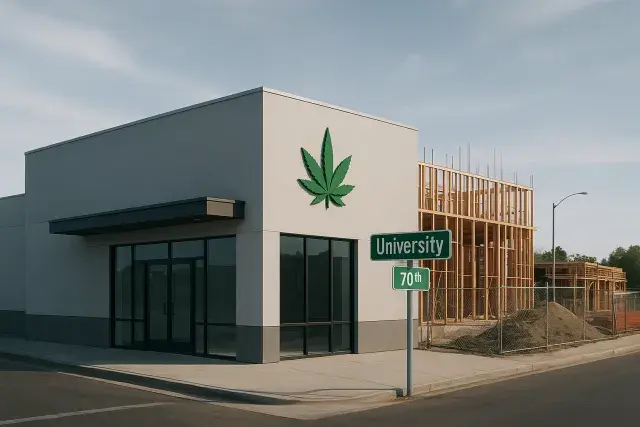
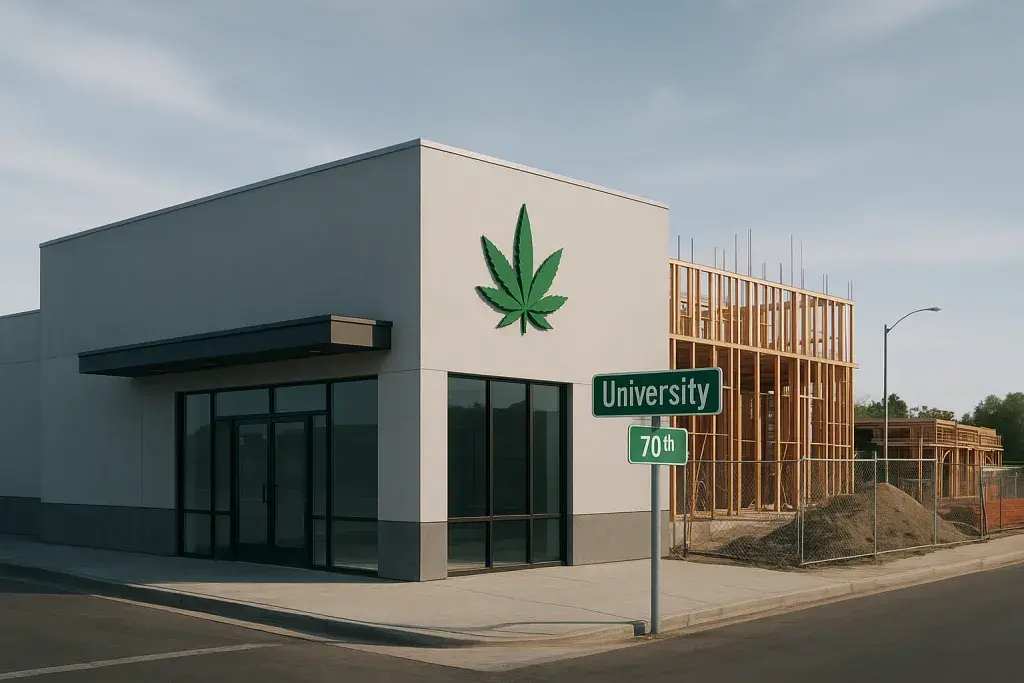
La Mesa is about to run out of room for cannabis retail. The city's 14th and final dispensary is under construction at University and 70th, and once it opens, zoning rules leave no path for another storefront within city limits. That's not a soft ceiling - it's a hard cap built into the municipal code, and it puts La Mesa in a position few California cities have reached: a fully saturated, legally capped adult-use and medical market in a jurisdiction of roughly 60,000 people.
How a city this size ended up with the densest cannabis retail footprint in East County comes down to two levers most operators watch closely: tax rate and zoning permissiveness. La Mesa's local cannabis tax sits at 4%, the lowest in San Diego County, layered on top of the state's 15% excise tax. That differential matters more than it sounds. A few percentage points on every ticket adds up fast for price-sensitive shoppers, and it's enough to pull customers across city lines from San Diego proper, where the local rate runs closer to 10%. Operators evaluating expansion or relocation in similarly built-out markets often lean on platforms like dispensary software in Ohio to model how local tax structures, zoning buffers, and POS reporting requirements shape unit economics before committing capital to a build-out. dispensary software in Ohio
The Buffer Zones Behind the Density
La Mesa's zoning rules require dispensaries to sit at least 1,000 feet from each other and from sensitive-use sites such as schools and churches. That buffer requirement is standard across California municipalities, but La Mesa applied it in a way that spread dispensaries across multiple corridors rather than clustering them in one industrial pocket. Center Street became the early proving ground - Sean McDermott's The Grove opened there in 2018 as the city's first medical dispensary - but the map has since filled in toward the borders, positioning some stores to pull traffic from neighboring jurisdictions that haven't legalized retail cannabis at all.
That border-adjacent placement is a deliberate retail strategy, not an accident. Dispensaries sited near city edges function as regional draws, absorbing demand from areas east where cannabis remains unavailable and from San Diego neighborhoods west where the tax bill runs higher. For operators, that's a lesson in how local tax policy and zoning geography combine to define a trade area - sometimes more powerfully than product selection or marketing ever could.
Revenue Plateau, Not Collapse
City officials describe cannabis tax revenue as having exceeded early projections before settling into a plateau, which is roughly what happens when a retail category matures and licensing caps out. Even at a flattened trajectory, the money isn't trivial: cannabis tax revenue is projected to funnel an estimated $2.5 million into La Mesa's general fund in the 2025-2026 cycle, money city officials say has helped fund additional police staffing. That's a fairly rare outcome in municipal cannabis policy - a lower tax rate producing durable, budgetable revenue rather than aggressive rates chasing a shrinking base.
Public Safety and Compliance in Practice
A recurring criticism of dispensary clusters is that they draw crime or strain police resources. La Mesa's experience, according to police officials, doesn't bear that out. Traffic patterns around dispensaries changed, particularly near Center Street, but calls for service tied specifically to dispensaries haven't outpaced those from other commercial tenants. Much of that comes down to standard compliance infrastructure now baked into licensed retail: armed security, continuous video surveillance, and inventory controls tied to seed-to-sale tracking systems. Surveillance footage from dispensary exteriors has become routine evidence in broader investigations, useful enough that at least one operator installed license plate readers during a store remodel.
None of this erases the underlying reality that cannabis remains a tightly regulated, age-restricted product with real compliance stakes - lab testing, compliant packaging, and point-of-sale age verification aren't optional extras, they're the baseline cost of staying licensed. La Mesa's experiment suggests that a modest tax rate paired with clear zoning can crowd out illicit-market activity without loosening those guardrails, which is the balance every city weighing a cannabis retail cap is ultimately trying to strike.